
Edwin Rubio Medina is a Colombian human rights lawyer and academic. He has been President (2009- 2011) and is current Vice President of the Colombian Association of Human Rights Lawyers (ACADEHUM). Mr Rubio Medina is a Committee member of the Movement of Victims of State Crimes (MOVICE), and a legal representative of victims of state crimes in the Huila department. He is also a member of the Latin American Network of Legal Anthropology (RELAJU). Since 2014, Mr. Rubio Medina has been working as an advisor to the Wayúu indigenous community in the south of Guajira against the effects of large scale mining in the region.
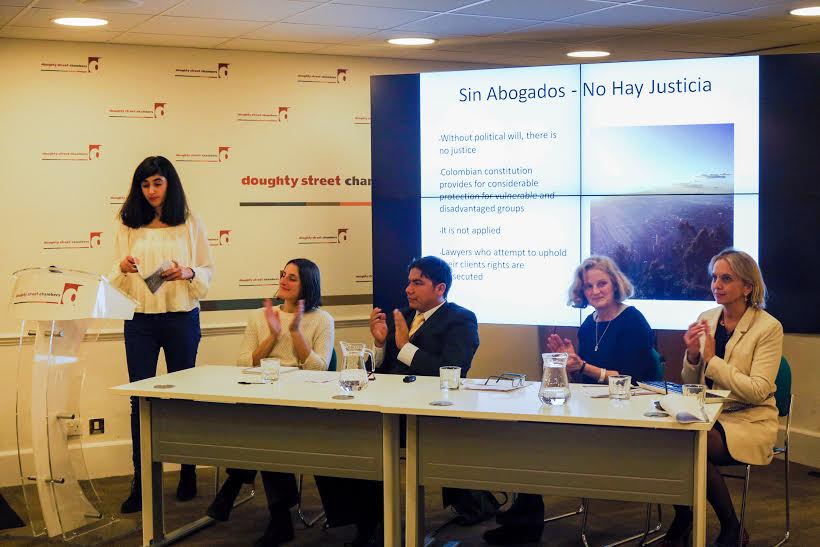
Mr Rubio Medina visited London in February 2016. He spoke to the Colombian Caravana about and sought international political and organisational support on:
- the transitional justice process;
- the current situation of human rights defenders in Colombia; and
- the serious humanitarian crisis being faced by indigenous peoples in the Guajira region due to the presence of multinationals in their territory.
Why did you decide to become a human rights lawyer?
I started studying Law in 2005 at the Universidad Surcolombiana. The region had been harshly affected by the armed conflict and the presence of Guerrilla groups had led to the unfounded stigmatisation of the local population as guerrilla supporters. I appreciated the injustices of the armed conflict and the need for legal help, so I worked with victims alongside my studies. I joined the Jose Alvear Restrepo Lawyers Collective (CAJAR) in 2009 and began to represent victims of extrajudicial killings in 2010.
How large is the current network of human rights organisations in Colombia?
The total number of human rights defenders in Colombia is relatively small. We are further marginalised and made invisible due to the stigmatisation that accompanies our work. The number of NGOs operating in Colombia is heavily outweighed by the number of victims, including in my region. Furthermore, international support for victims has waned in recent years, focussing instead on the Peace Talks and conflicts in other countries. Organisations therefore have a double duty: to resist external pressure and protect what they have achieved to date with little help, whilst trying to move forward.
Have you suffered threats or attacks because of your work defending human rights – can you tell us about them?
When I first visited London as president of ACADEHUM, my phone was tapped and over a long time I received calls and messages that were completely silent, or the playback of a recording of myself speaking. The intention was to intimidate me.
For the time being, the calls have stopped for me. However, regular threats still have disastrous consequences for our organisations and the ability of human rights defenders to carry out their work. Only recently, a colleague of mine received a call that if she attended a meeting with me the following day, her life would be at risk. She was pushed to leave ACADEHUM out of fear.
Both CAJAR and ACADEHUM have suffered attacks on their offices and web page. We have suffered theft of information and received false documents that appear to be our own. The ACADEHUM office has been broken into in the past, and a computer has been stolen from me.
Do you or your organisation have any protection measures? What kinds of measures are important to protect human rights lawyers and other human rights defenders in Colombia?
Aside from work in its offices, ACADEHUM engages in fieldwork in a number of regions. Some ACADEHUM members have been granted protection measures from the Inter- American Court of Human Rights and the National Protection Unit. However, these are not always implemented. For example, the human rights defender Rommel Duran is at an extraordinary risk and as such should be given a protection scheme, but this has not yet been implemented.
As your work is so dangerous, why do you continue to do it?
There is a great opportunity now for human rights defenders to contribute to the peace process and to continue helping victims, especially alongside the National Movement of Victims of State Crimes (MOVICE).
Colombia still has a lot of work to do regarding issues of land, living standards and truth and justice, but I believe that this peace process is opening the door for Colombia to move firmly into the 21st Century. My predecessors in the field never had the chance to see this solution on the horizon, so I am honoured to be part of it.
In your opinion, what have been the most pervasive hindrances to the defence of human rights in Colombia?
Firstly, we still have a 95% impunity rate. The cases of extrajudicial killings I have worked on since 2010 remain at the preliminary stage; as years pass processes do not seem to advance and cases are not solved. Impunity is heightened by the separate military penal system.
Secondly, Law 906 of 2004 makes it very difficult for lawyers who defend victims to access the archives of the public prosecutor. Copies of records of what has been investigated or found, persons involved and their testimonies are almost impossible to get hold of. This restricts lawyers’ access to evidence that could contribute to their cases.
Third, today lawyers have to finance their own experts. Procedural charges are therefore imbalanced, because victims do not have the means to fund investigations.
What do you think the international community can do to support the work of human rights lawyers and defenders in Colombia?
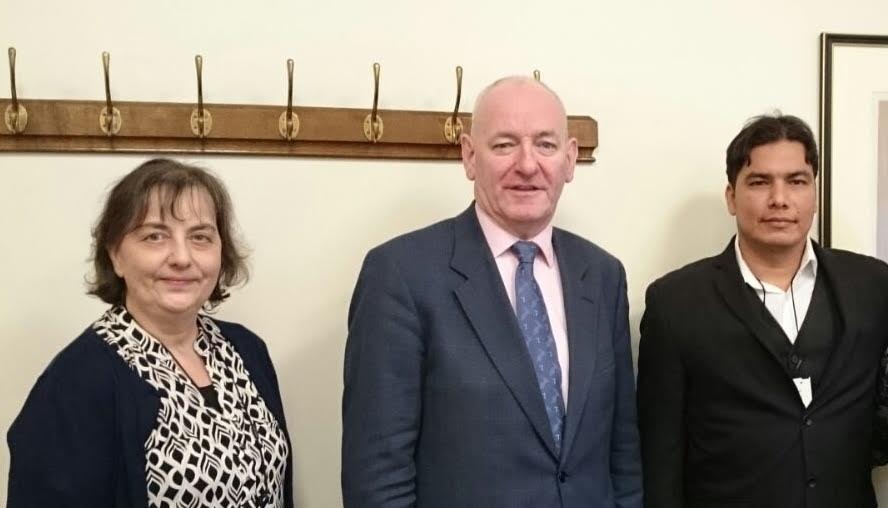
It is essential that there be an effective demobilisation of paramilitaries in Colombia. We have met with members of the UK Parliament and asked them to monitor the post- conflict human rights situation in Colombia.
We will soon be in Geneva speaking on Transitional Justice in order to encourage international support for the process. It is important to have public expressions from the international community on the situation in Colombia and the proper funding of the public prosecutor’s office, to fight against impunity.
Once the Inter-American Court of Human Rights abandons a particular case, there is a wave of difficulty for human rights in that country. It is very important that the impunity of Guatemalan General Efraín Ríos Montt, for example, is not repeated, and to remember that corruption and impunity run the risk of causing more conflict in the future. The international community is essential to ensuring lasting peace in Colombia.
In the light of the current peace negotiations, what future do you see for Colombia, and what are the challenges?
The peace process is the best opportunity for Colombia to leave its historic past behind. Colombian land reform has been a problem since the 16th century, and guerilla movements proffer 19th century socialist ideals. The real challenge is to reach a peace process that includes a programme of social change. We need a reduction in military spending, so that funds can be used to enhance quality of life, living standards, education and the environment. Continuing with neo- liberalist policies would frustrate the peace process and render it useless.
You currently advise the Wayúu indigenous community against large scale mining. Why is this important to you?
Defending the rights of indigenous communities in the region surrounding the Cerrejón mine includes various issues: displacement of communities, killings by paramilitaries, corruption, illegitimate press tactics and the appropriation of natural resources such as water. It is difficult for indigenous communities to maintain their strength and resistance against the mining company, whose resources dwarf their own.
The Wayúu is one of the last communities to be influenced by outside society. They seek physical and cultural protection and it is the duty of all humanity, especially of Latin Americans, to protect our original peoples, their wisdom and historical legacy. Still, the voices of Indigenous, Afro-Colombian and women’s communities are marginalised and are currently not included in the peace process.
Can you tell us about other cases you are working on at the moment and why these are important for human rights in Colombia?
False allegations of corruption are being brought against an ombudsman, Pablo Segundo Ojeda Gutiérrez who has tried to protect an Afro-Colombian community in La Guajira. False charges continue to be brought against human rights lawyers involved in cases concerning the Cerrejón mine.
A former Judge from Cali, Edgar Zúñiga Hormiga, has been imprisoned following a political decision. He is still waiting for the judgement on his second appeal. Judge Juan de dios Solano has been also imprisoned for four years following his judgement on a habeas corpus application. The appeal against the imprisonment of human rights defender David Ravelo Crespo has also been dismissed. The case is currently under consideration at the Inter- American Human Rights Commission.